The Bucket Is the Log: Building an Append-Only Log on Object Storage in Go
Build an append-only log on object storage in Go using immutable segments, a bounded catalog, writer fencing, and replay by LSN or timestamp—without a broker.
This started as a UnisonDB replication problem
UnisonDB is a log-native streaming database. Its active HA writer already streamed committed WAL records over gRPC, allowing connected replicas to receive small batches quickly and apply them in order.
The need for another path became concrete in March 2026, when a user opened UnisonDB issue #208. Their deployment had a centralized control-plane writer and read-only edge nodes, but establishing direct connectivity between them was difficult. They wanted S3, or an S3-compatible service, to act as the intermediate replication layer and were willing to accept the additional latency.
That request exposed the boundary of the existing design. gRPC was the right path for live replication, but it required each replica to remain connected to the active writer. A disconnected or newly started replica still needed durable history it could replay without depending on that writer process. We therefore wanted the same committed WAL to be published through object storage as well.
The second path was not meant to replace gRPC. It had a different job:
- publish the WAL once and let many replicas catch up without keeping a connection to the writer;
- preserve replayable history after the writer process has gone away;
- let a new replica start from an exact LSN or timestamp;
- survive HA writer replacement without two writers extending the same sequence;
- use the S3, GCS, Azure, or MinIO bucket we already operated, with no broker in between.
                                      gRPC -> connected replica
committed UnisonDB WAL -> one order --+
                                      object storage -> catch-up and replay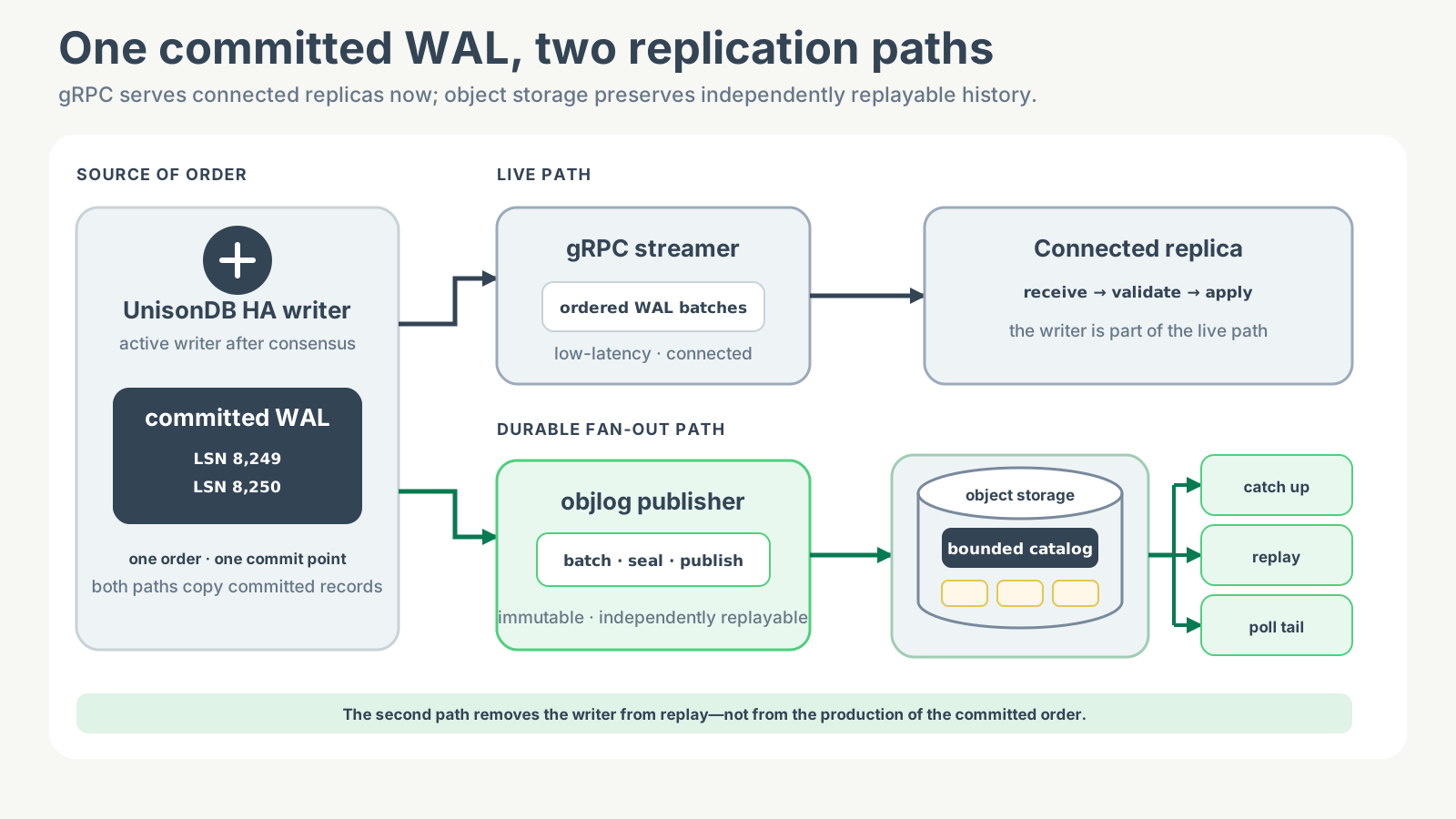
The first idea was to upload UnisonDB’s existing WAL segment files. That looked like reuse. It was actually the wrong storage boundary.
The local WAL was crash-safe—but it was the wrong remote format
UnisonDB’s WAL was built for local durability and streaming replication. Building a Corruption-Proof Write-Ahead Log in Go explains how checksummed records, a trailer marker, 8-byte-aligned frames, directory sync, and conservative recovery make incomplete or corrupted writes detectable before they are replayed locally or streamed to a follower.
That design gives recovery and connected replicas an ordered sequence of complete, validated records. It solves the local WAL problem well. It does not make the segment a useful object-storage format.
That format is implemented in pkg/walfs and built for local disk. A segment is a preallocated memory-mapped file with a mutable 64-byte header followed by individually checksummed record frames:
+--------------------+----------------------+----------------------+-----+
| mutable header     | record 0             | record 1             | ... |
| write offset       | CRC + value + marker | CRC + value + marker |     |
+--------------------+----------------------+----------------------+-----+

record offsets -> in-memory index -> separate local index file
That layout solves its local problem well. Appends are cheap, checksums detect damaged records, the trailer distinguishes a finished record from an interrupted write, and recovery stops at the first frame it cannot validate.
Uploading a sealed copy would preserve the bytes, but it would not create a useful remote log:
| Local WAL assumption | Object-storage consequence |
|---|---|
| The header and write offset change while the segment is active | A completed object cannot be appended to or patched in place |
The file is preallocated for mmap |
Uploading it can include capacity that contains no records |
| Records are stored as raw individual frames | A reader must fetch the whole object or perform many tiny range requests |
| Record offsets live in a sidecar index | The object is not independently searchable |
| The format has no block-level LSN or timestamp summaries | Seeking remotely requires scanning records |
| Local rollover determines when a file seals | Replication visibility becomes tied to the local WAL’s segment size |
The local format was not deficient. It was optimized for a different I/O boundary. A local WAL can mutate pages and keep sidecar state. A remote segment should be immutable, compressed, self-indexed, and useful through a small number of range reads.
That required a new format.
Define segformat from the read path backward
Before writing the object, I started with the read I wanted:
seek to LSN 8,250
  -> read a small fixed trailer
  -> locate the embedded block index
  -> find one compressed block
  -> range-read and decode only that block
We did not invent that shape from scratch. We took inspiration from immutable file formats that are also designed backward from their read path.
A LevelDB SSTable writes sorted, optionally compressed data blocks first, places an index after them, and ends with a fixed-size footer containing the location of that index. A reader starts at the footer, follows the index to one data block, and avoids scanning the complete file. RocksDB’s block-based tables extend the same family of ideas with richer and partitioned indexes.
Apache Parquet applies a similar rule to a different workload. It writes file metadata after the column data, allowing a writer to produce the file in one pass. A reader examines the tail first, learns where the required column chunks live, and then reads only those ranges.
LevelDB SSTable -> data blocks              -> index         -> fixed footer
Parquet         -> column chunks            -> file metadata -> length + magic
segformat       -> compressed record blocks -> block index   -> fixed trailer
The details are different, but the lesson transfers cleanly to object storage: for an immutable object, make the tail the entry point. A small range read should reveal the index, and the index should reveal the smallest data range that can answer the request.
The resulting format is segformat v2. One immutable object contains everything needed to validate and search it:
file preamble
block 0 preamble + compressed records
block 1 preamble + compressed records
...
index preamble + block index
fixed 192-byte trailer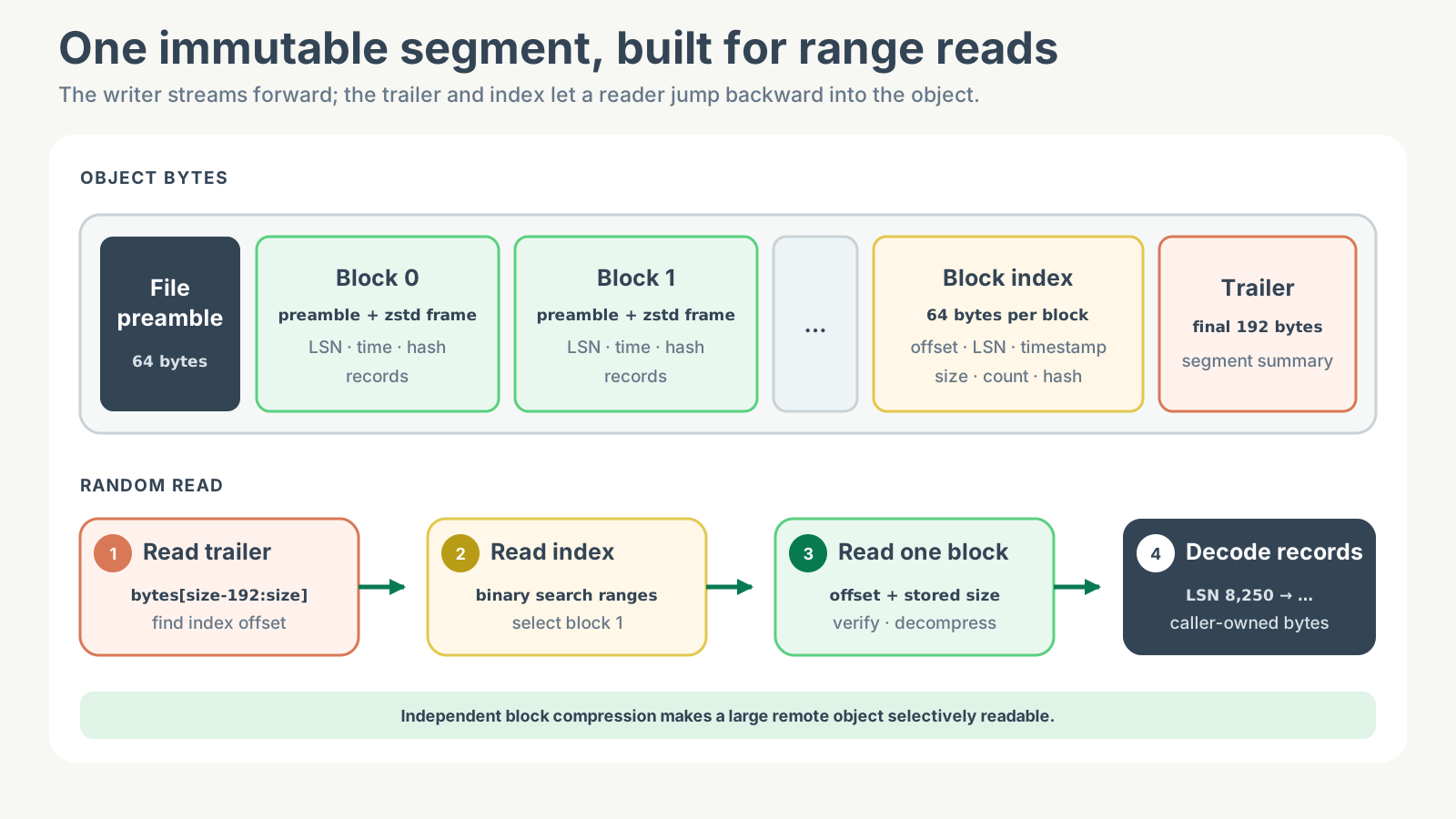
The layout buys us several properties at once.
The writer never backpatches the object
The 64-byte file preamble contains only values known before streaming begins: version, partition, codec, base LSN, segment ID, and writer ID. Final sizes, counts, ranges, and hashes go into the trailer at the end.
That matters for multipart upload. The writer can compress blocks and emit bytes forward without seeking back to rewrite the beginning.
Compression remains randomly readable
With the default zstd codec, each block is one independent frame. A reader that needs one record downloads the selected block, not one compression stream spanning the complete segment.
Every 64-byte block-index entry includes the block offset, stored and raw sizes, record count, base LSN, timestamp bounds, and hash. The same summary is also present in the block preamble, so the index and block can be checked against each other.
LSN and time are both search keys
Records inside a block have non-decreasing timestamps and dense LSNs. The LSN does not need to be stored with every record:
record LSN = block base LSN + record indexThe index can therefore locate a block by LSN or by its maximum timestamp, then scan only inside that candidate block.
One object carries its index and integrity proof
The block index sits inside the same object, immediately before the trailer. Block, index, and segment hashes detect corruption at the boundary where it is read. No local sidecar is required to interpret the remote bytes.
The bytes are not tied to the Go implementation
All integer widths, byte order, limits, magic values, codecs, and validation rules are published. Checked-in binary fixtures pair encoded bytes with language-neutral expected values. A future reader does not have to reverse-engineer whichever Go structs happened to write the object.
segformat solved the first problem: how to turn ordered WAL records into one immutable, compressed, range-readable object.
It did not yet solve the log.
From a UnisonDB component to objlog
A bucket full of valid segments still needs an order, a commit boundary, writer fencing, bounded metadata, checkpoints, and retention. None of those concerns were specific to UnisonDB records. The segment payload could just be bytes.
The object-store replication layer therefore grew into a reusable storage protocol and later moved into its own repository as objlog.
objlog is an embedded Go library for partitioned logs on S3-compatible storage, Google Cloud Storage, and Azure Blob Storage. A writer batches records into segformat objects. A small catalog publishes which objects belong to the committed log. Readers discover committed ranges through that catalog and read the selected blocks directly from the bucket.
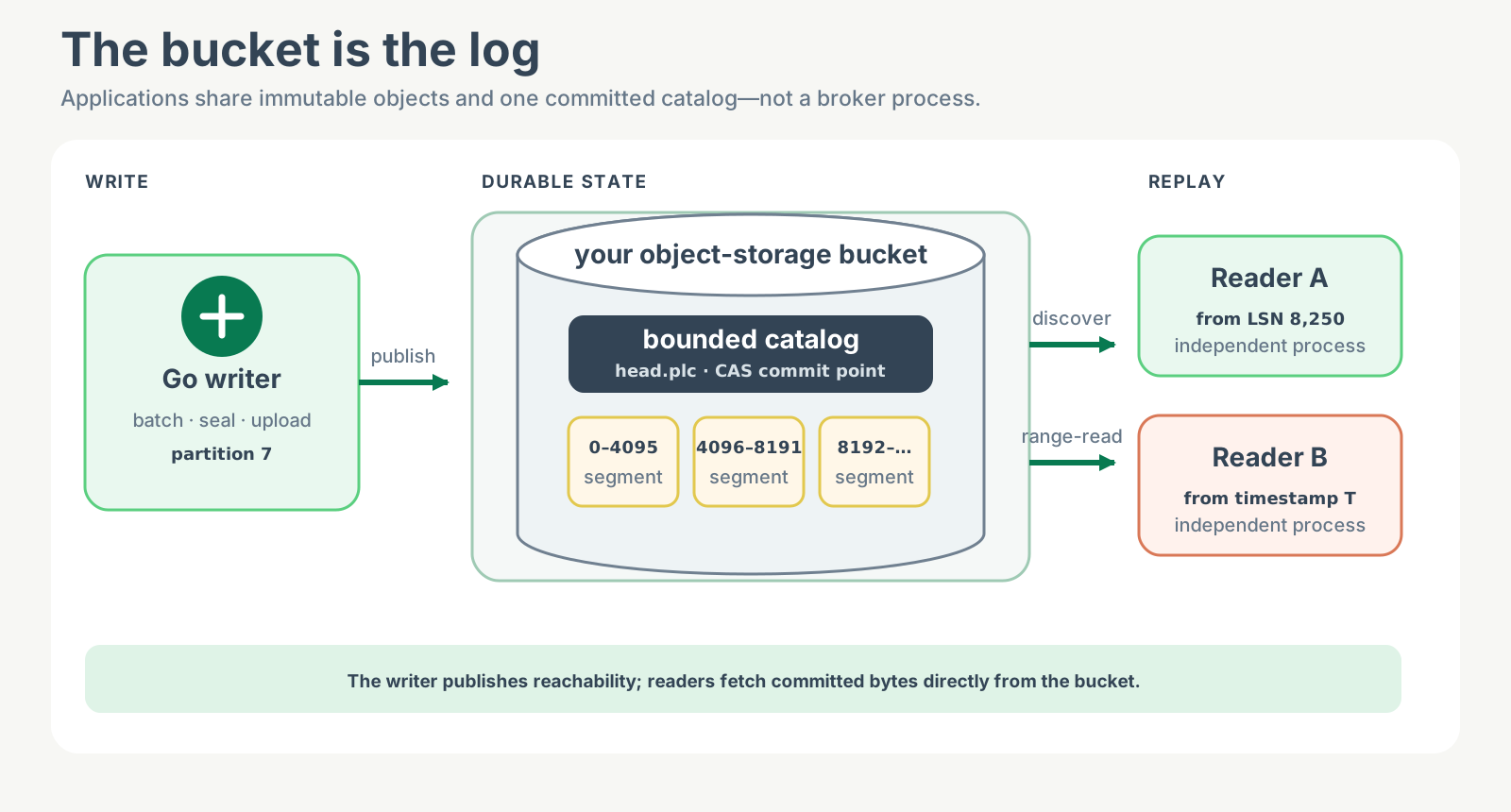
This is not a smaller Kafka. It makes a different trade. Kafka provides live delivery, replicated brokers, and consumer-group coordination. objlog is for durable history that applications can reopen and replay from their own bucket.
A valid segment is not yet a log
If the bucket contains ten valid segment objects, which ones belong to the committed sequence?
Listing a prefix is not enough. A segment may have finished uploading just before its writer crashed. Another may belong to a writer that lost ownership. A third may have been prepared for a catalog update that never committed.
Every record receives a log sequence number, or LSN, within one partition:
partition 7

LSN 40  -> order-created
LSN 41  -> payment-authorized
LSN 42  -> shipment-created
The LSNs are dense. If a segment begins at 40 and contains three records, its inclusive range is [40, 42], and the next segment must begin at 43.
The writer maintains two different positions:
optimistic next LSN -> next number assigned by the local writer
committed next LSN  -> first number not yet visible in the catalog
Those positions may differ while a cut segment is being compressed, uploaded, or published.
This is why Append and Flush have different contracts:
appended, err := writer.Append(ctx, objlog.Record{
	TimestampMS: time.Now().UnixMilli(),
	Value:       []byte("payment-authorized"),
})

snapshot, err := writer.Flush(ctx)
Append assigns appended.LSN and accepts the record into writer-owned memory. It is not a durable acknowledgement. Flush cuts the active batch, waits for every earlier segment to be uploaded and published in order, and returns the committed head.
That distinction is easy to miss:
Append success -> this writer accepted the record
Flush success  -> a reader can discover the record from the bucket
Cut sits between them. It rotates the active batch and lets background work begin, but it does not wait for catalog publication.
The active batch is mutable only inside the writer process. Once cut, records move through compression and hashing workers, an ordered emitter restores block order, and a bounded multipart stream uploads the immutable segment. Compression may complete out of order; segment bytes may not.
Now we need a publication boundary that says which uploaded segments belong to the log.
Uploading a segment does not commit it
Now we can produce a durable object. We still must decide whether it belongs to the log.
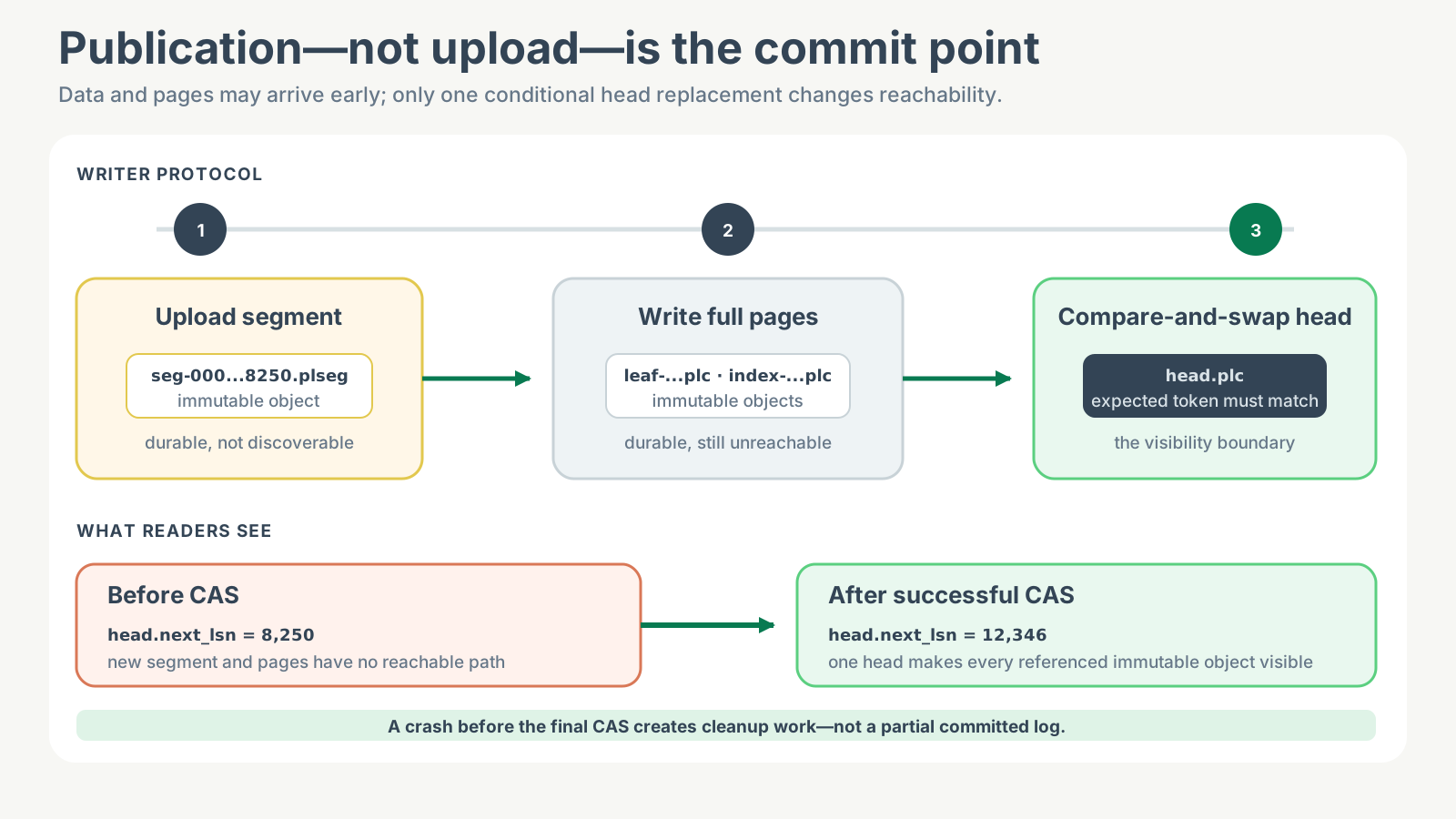
objlog uses a data-first, metadata-second protocol:
1. seal and upload the immutable segment
2. prepare any immutable catalog pages
3. replace the partition head with compare-and-swap
Only step 3 changes reader visibility.
In simplified pseudocode:
segment := upload(batch)
nextHead := appendSegment(currentHead, segment)

if !compareAndSwap("head.plc", currentToken, nextHead) {
	return ErrStaleWriter
}
This ordering turns several failures into understandable states:
| Failure point | Reader-visible result |
|---|---|
| Before segment completion | No committed segment |
| After segment upload, before head publication | Durable but unreachable orphan |
| After catalog page upload, before head publication | Durable but unreachable page |
| Head compare-and-swap loses | Old committed log remains authoritative |
| Head compare-and-swap succeeds | Segment and referenced pages become visible together |
The protocol does not need a multi-object transaction. Immutable objects can arrive early because readers reach them only through one conditionally replaced head.
S3 implements the head update with If-Match against the ETag previously loaded; creation uses If-None-Match: *. GCS uses generation preconditions, and Azure Blob uses ETag conditions. The token differs, but the required operation is the same:
Replace this object only if it is still the version I read.
The provider behavior is documented in the official guides for S3 conditional writes, GCS generation preconditions, and Azure Blob optimistic concurrency.
Fence the writer through the same head
Compare-and-swap also gives us writer fencing.
When a writer opens partition 7, it does not acquire a process-local mutex. It loads the catalog head, increments the writer epoch, installs a new writer ID, and conditionally replaces the head.
Suppose writer A owns epoch 4:
head: epoch=4 writer=A nextLSN=100Writer B takes over and publishes:
head: epoch=5 writer=B nextLSN=100A may still be alive. It may even finish uploading a segment that begins at LSN 100. But its segment carries epoch 4 and writer A’s identity. It cannot publish behind a head owned by epoch 5.
writer A segment -> epoch 4 -> rejected
writer B segment -> epoch 5 -> eligible to publish
The object-store condition prevents A from replacing the newer head, while the epoch and writer ID prevent an accidentally replayed request from being accepted as B’s work.
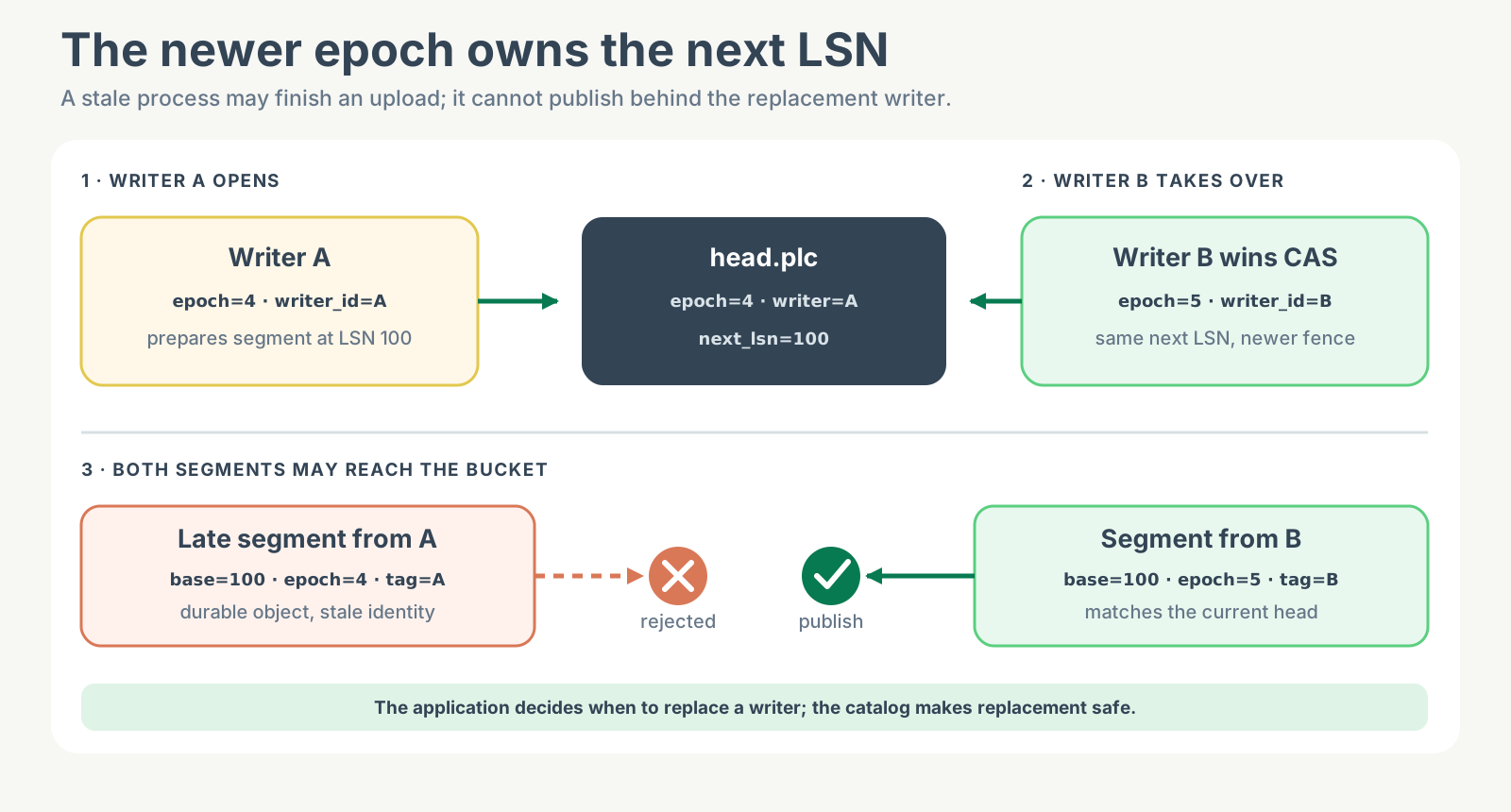
There is an important limit hidden here. objlog does not run leader election or decide when a writer is dead. The application decides when to open a replacement writer. The catalog only makes that takeover safe.
Ordering is per partition. If more write throughput is needed, use more partitions and choose the partition in the application. There is no cross-partition total order or transaction.
Why not keep every segment in one manifest?
After publication, a reader needs to map an LSN to a segment. The first catalog design could be one JSON document:
{
  "segments": [
    {"base_lsn": 0, "last_lsn": 4095, "key": "..."},
    {"base_lsn": 4096, "last_lsn": 8191, "key": "..."}
  ]
}
It works until history becomes large. Every append must download, decode, extend, encode, and upload metadata proportional to the lifetime segment count. Readers must load the same history even when they want one recent record.
objlog keeps the mutable catalog head bounded by paging completed history into immutable objects.
With the default fan-out of 128:
- The head keeps fewer than 128 open segment entries.
- When that leaf fills, it becomes an immutable leaf page.
- The head keeps fewer than 128 references to completed leaf pages.
- When that level fills, it becomes an immutable index page and one reference moves up.
- The carry continues through higher levels.
This behaves like a base-128 counter whose digits are the unfinished right edge of a tree.
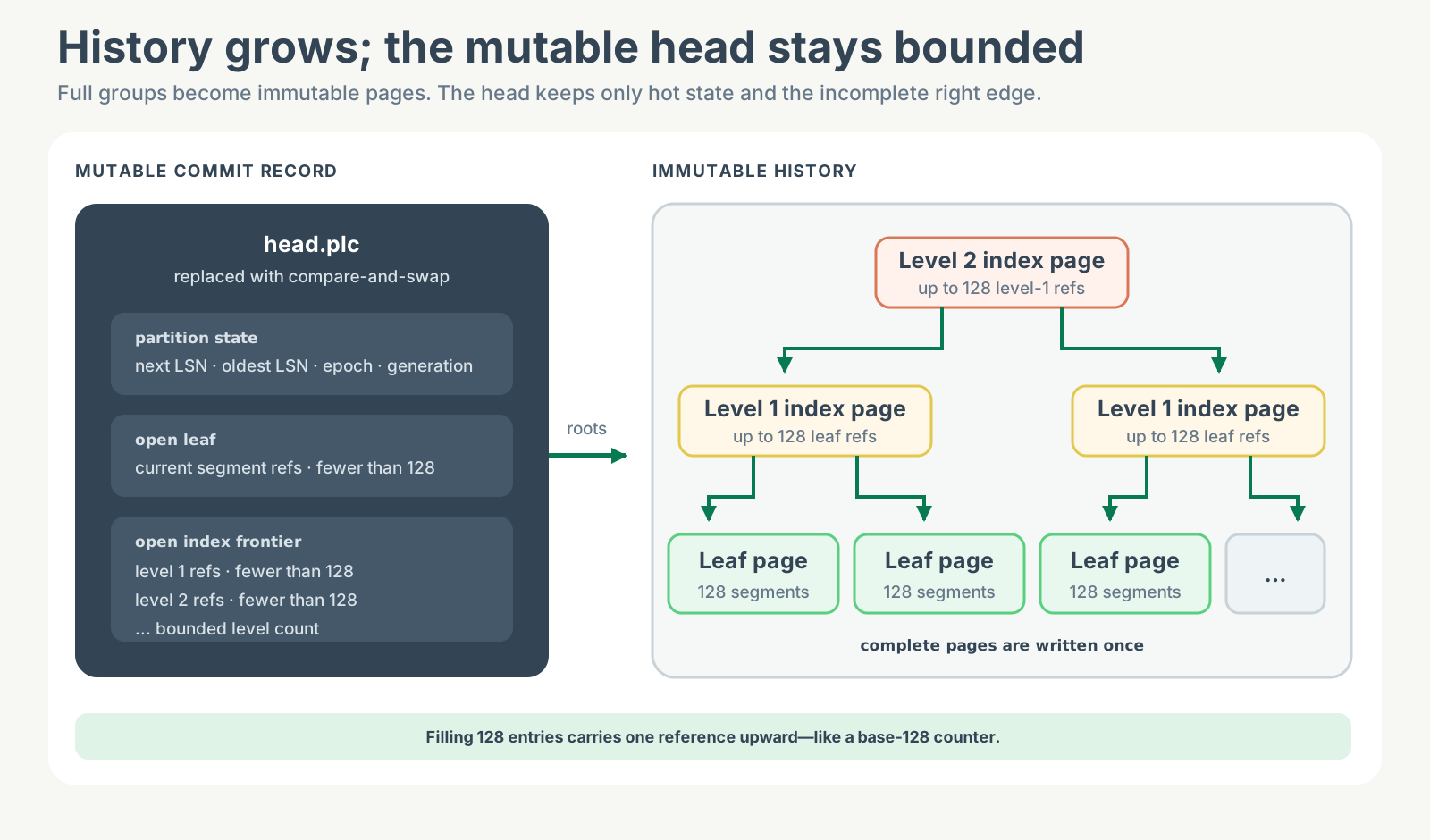
One segment publish may seal a leaf and cascade through several index levels. Those page objects are written first. One CAS of head.plc then commits the new segment and every new page reference together.
The head still contains the hot partition state:
next_lsn
oldest_lsn
writer_epoch and writer_id
generation
lifetime and reachable segment counts
last segment summary
open catalog frontier
It does not grow linearly with the partition’s history.
The catalog is also ordered by timestamp bounds. LSN ranges are contiguous, and segment timestamp ranges must be non-decreasing. The writer rejects a timestamp regression. That invariant lets the same tree answer two kinds of lookup.
The exact page and head encoding is specified in catformat v1.
Replay is a two-stage range read
Suppose a reader asks for LSN 8,250.
The reader performs two searches:
catalog search -> find the segment containing 8,250
segment search -> find the block containing 8,250
At the catalog level, it loads head.plc, selects the root range containing the LSN, and descends immutable index pages until it reaches a segment reference.
At the segment level, it range-reads the final trailer, reads the block index, binary-searches the index, and fetches only the selected block range. It does not download every segment before the target, and it does not need the writer process.
Timestamp replay follows the same shape:
catalog page max timestamps -> candidate segment
segment block max timestamps -> candidate block
records inside block         -> first timestamp >= target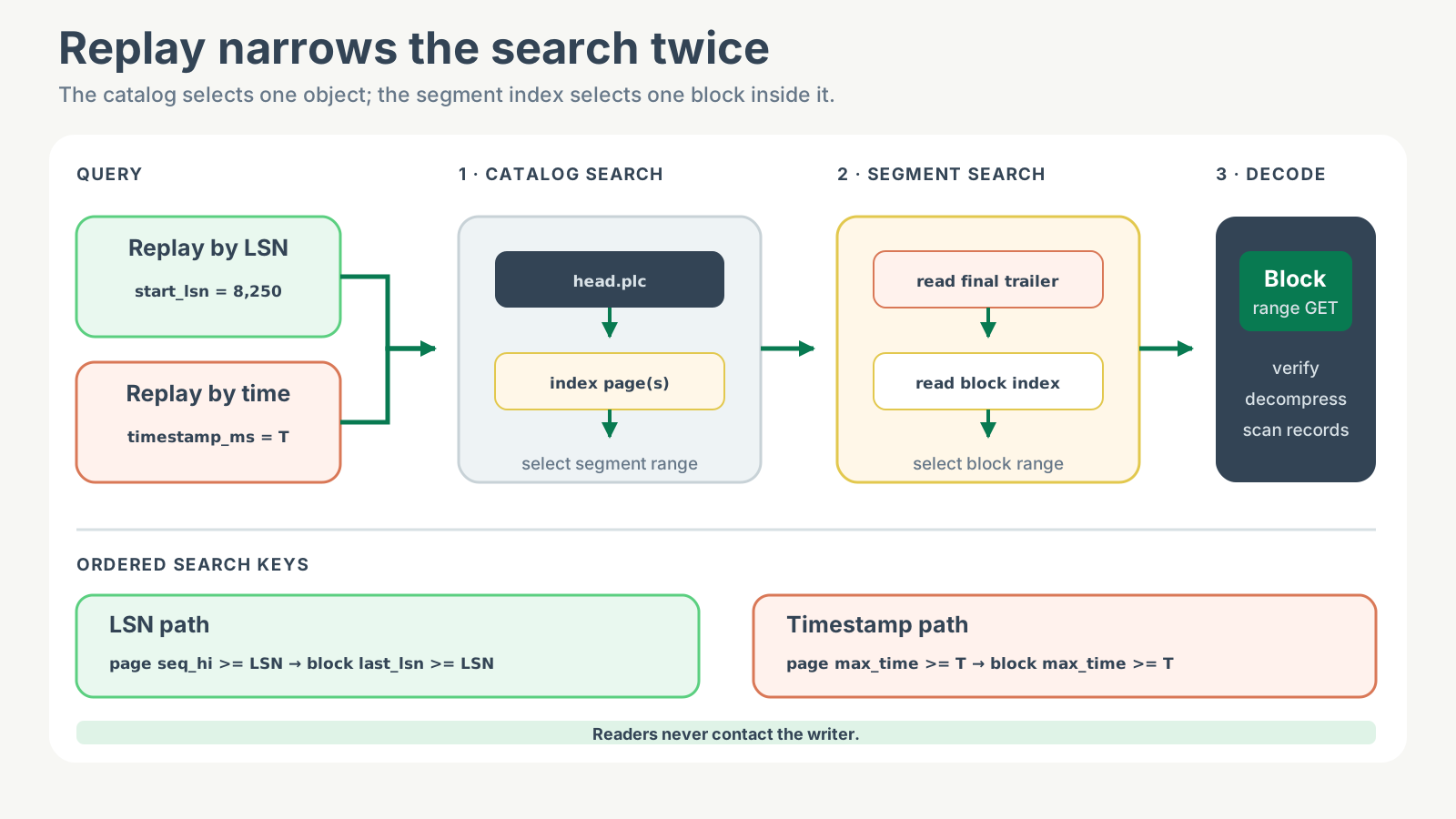
The format specification gives a useful scale example. At the default fan-out of 128, a partition with ten million segments needs at most four catalog GETs for a lookup: the head, a level-2 page, a level-1 page, and a leaf page. The record bytes then come from segment range reads.
Reading from Go
First create a provider store. This example uses S3, but the GCS and Azure packages expose the same objlog.Store boundary:
store, err := objs3.New(objs3.Options{
	Client:   s3Client,
	Bucket:   "events",
	Prefix:   "prod",
	StreamID: "orders",
})
if err != nil {
	return err
}

log, err := objlog.Open(objlog.Options{Store: store})
if err != nil {
	return err
}
defer log.Close()
Open one fenced writer for a partition:
writer, err := log.OpenWriter(ctx, objlog.WriterOptions{
	Partition: 7,
	WriterID:  uuid.New(),
	Batch: objlog.BatchPolicy{
		MaxDelay:   time.Second,
		MaxBytes:   64 << 20,
		MaxRecords: 16_384,
	},
})
if err != nil {
	return err
}
defer writer.Abort(context.Background())
The first configured batch limit wins. MaxBytes is measured before compression. MaxDelay begins when the first record enters a non-empty batch. If cut segments accumulate faster than the bucket and catalog can publish them, BackpressurePolicy bounds the pending batches and bytes rather than allowing memory to grow without limit.
Replay a committed range:
partition := log.Reader().Partition(7)

batch, err := partition.Read(ctx, objlog.ReadRequest{
	StartLSN:  8_250,
	Limit:     1_000,
	Freshness: objlog.FreshnessOnTail,
})
if err != nil {
	return err
}

for _, record := range batch.Records {
	fmt.Printf("%d %s\n", record.LSN, record.Value)
}
Read is passive. It returns committed data and never waits for future records.
The freshness setting controls catalog reloads:
FreshnessCached  -> use a cached head when one exists
FreshnessOnTail  -> refresh when the request reaches the cached tail
FreshnessLatest  -> refresh before the read
The default is FreshnessOnTail, which lets replay move through known history without reloading the head for every batch.
A cursor is not a broker-side consumer offset
A cursor is a local position over the shared reader runtime:
cursor, err := partition.Cursor(objlog.CursorOptions{
	StartLSN: 0,
	Limit:    1_000,
})
if err != nil {
	return err
}
defer cursor.Close()

batch, err := cursor.Next(ctx)
checkpoint, err := cursor.Checkpoint(ctx)
The checkpoint is deliberately more than one integer:
{
  "version": 1,
  "stream_id": "orders",
  "partition": 7,
  "next_lsn": 1000
}
Persist the complete value in application-owned storage after processing the batch. On resume, objlog validates the stream, partition, current tail, and retention floor. A checkpoint from another stream is rejected. A checkpoint below oldest_lsn returns an expiration error instead of silently jumping forward.
objlog does not maintain consumer groups or commit offsets on behalf of applications. Two consumers may keep checkpoints in PostgreSQL, another object, a workflow engine, or anywhere else that fits their processing contract.
Tailing is explicit polling with a blocking API
There is no broker connection waiting to push the next event. Following the live tail means refreshing the catalog head.
The library makes that work explicit through a Watch:
watch, err := log.Reader().Watch(ctx, objlog.WatchOptions{
	Partitions: []uint32{7},
})
if err != nil {
	return err
}
defer watch.Close()

tailer, err := watch.Tail(objlog.TailOptions{
	Partition: 7,
	StartLSN:  batch.NextLSN,
	Limit:     1_000,
})
if err != nil {
	return err
}
defer tailer.Close()

next, err := tailer.Next(ctx)
Tailer.Next returns immediately when committed records are available. At the tail it blocks until the watch observes a newer head or the context is canceled.
The watch polls selected partitions on a configurable interval and bounds concurrent refreshes. Passive readers start no background loop. That distinction prevents a reader created for an occasional historical query from becoming an accidental permanent polling service.
Retention changes reachability before it deletes bytes
Deleting old history is another multi-object operation, so it uses the same separation between visibility and physical objects.
Retention has three explicit stages:
request intent -> fenced catalog update -> delayed physical deletionFirst, any process records a monotonic request:
_, err := log.RequestRetention(ctx, objlog.RetentionRequest{
	Partition:     7,
	PolicyVersion: 42,
	BeforeLSN:     1_000_000,
})
This does not change what readers see.
Second, the active writer applies the latest request through its existing fence:
result, err := writer.ApplyRetention(ctx)The head advances oldest_lsn and drops catalog references below the effective boundary. Segments are immutable, so a boundary that lands inside a segment retains that complete segment. The effective oldest_lsn may therefore be lower than the requested LSN.
Finally, a separately scheduled reclaimer waits through a grace period and deletes objects that are no longer reachable. A slower scrub also finds uploads and catalog pages that were never committed because a writer crashed or lost its fence.
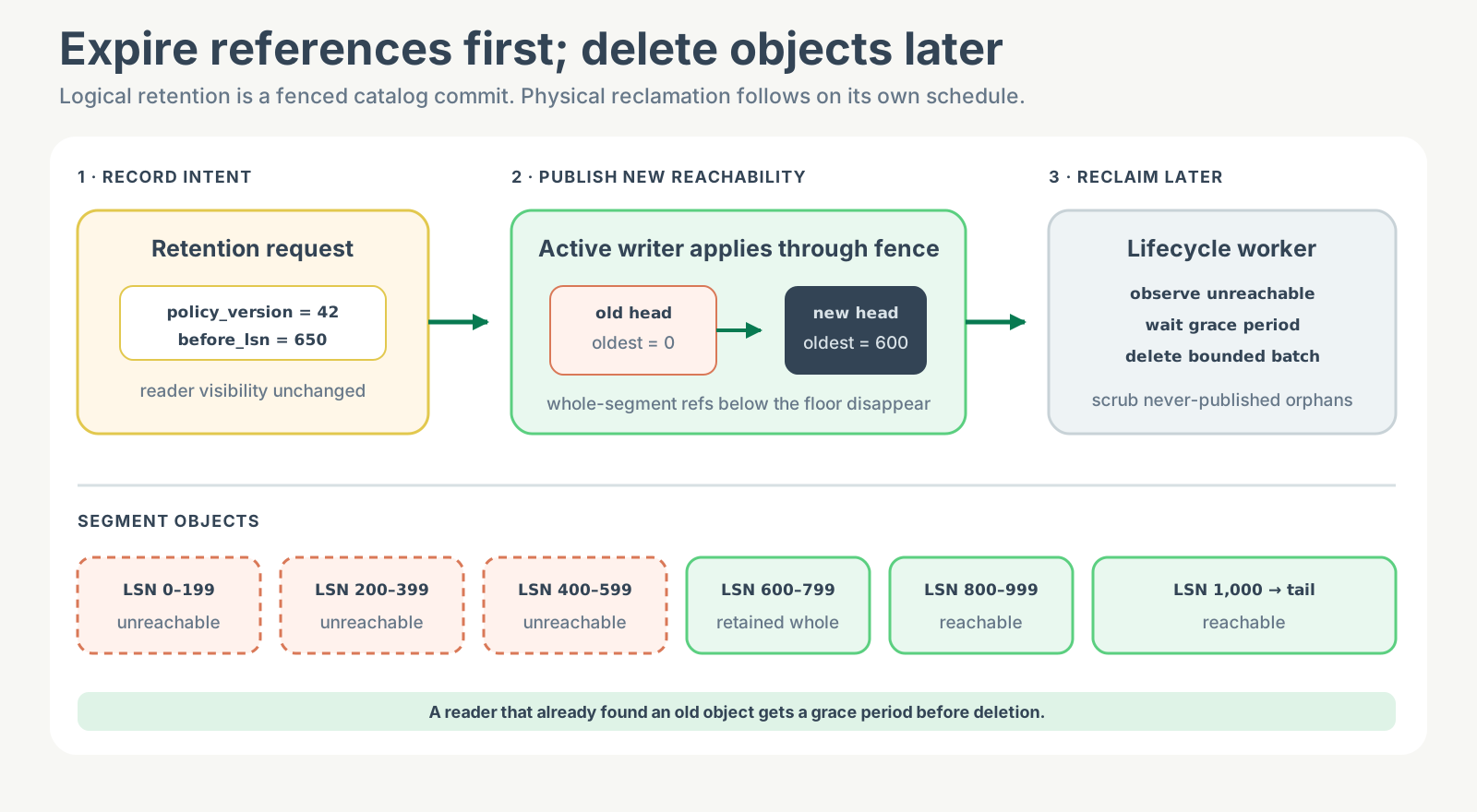
The order protects readers that already discovered an old segment:
new reads stop discovering it
existing reads get a grace period
only then may GC delete it
Nothing schedules retention or GC implicitly. Partition discovery, cadence, and maintenance ownership remain application decisions.
A published format is part of the API
The Go library is one implementation of the log. The bytes in the bucket are the durable interface.
objlog publishes two specifications:
| Format | Contains |
|---|---|
segformat v2 |
Segment preambles, blocks, records, index, and trailer |
catformat v1 |
Mutable head, immutable leaf pages, and immutable index pages |
Both formats use fixed-width metadata, explicit versions, bounded counts, integrity hashes, and checked-in binary fixtures with language-neutral expected values. An unknown version is rejected instead of guessed.
That matters even if every current reader is written in Go. A durable format should survive a refactor, a second implementation, and the process that originally wrote it. A Rust, Java, Python, or C++ reader can derive object keys, validate the catalog, range-read a segment, and decode records without calling a Go service.
What “no broker” gives us—and what it does not
Removing a broker removes a category of operation:
no broker cluster
no broker replication configuration
no broker-local copy of the durable history
no reader-to-writer connection
no partition process kept alive while the stream is idle
It does not remove distributed-systems costs. The object store is remote. Conditional writes have latency and request cost. Tailing observes catalog refreshes rather than receiving an immediate broker push. A single partition has one fenced writer, and applications own producer retry semantics and consumer checkpoints.
objlog fits when the primary need is durable history:
- audit and compliance streams that must remain in an owned bucket;
- replay and reprocessing by LSN or time;
- sparse or intermittently active partitions;
- independent readers that should not require a running writer;
- pipelines where object-store latency and batched visibility are acceptable.
Use a broker when the primary need is live messaging:
- low-latency delivery to connected consumers;
- consumer groups and automatic partition assignment;
- broker-managed acknowledgements and offsets;
- high-frequency small writes that must become visible immediately;
- an established streaming ecosystem and protocol.
Kafka, for example, provides replicated brokers and coordinates partition ownership across consumers in a group. Those are valuable features, not accidental overhead. The Kafka documentation describes that live event-streaming model directly.
The two systems can also compose: publish to a broker for live delivery and keep replayable long-term history in object storage.
The catalog head is the commit record
We began with what looked like one upload:
append -> object storageThe complete protocol is richer:
append
  -> assign dense per-partition LSN
  -> batch records
  -> seal independently readable blocks
  -> upload an immutable segment
  -> write any immutable catalog pages
  -> conditionally publish one bounded head
  -> let readers replay directly from the bucket
The immutable objects carry the history. The catalog gives that history an order and a visibility boundary. The fence says who may extend it. Range indexes make it practical to reopen. Retention removes references first and bytes later.
The runnable objlog examples exercise that complete lifecycle through the public API: write and flush records, replay by LSN or timestamp, resume from a cursor checkpoint, follow the live tail, advance retention, and reclaim unreachable objects. The same demo can run in-process with a fake GCS server or against MinIO and Azurite through Docker Compose.
That is the central idea behind objlog:
The segment upload stores bytes. The catalog head commits the log.
Once that boundary is explicit, object storage stops looking like an inconvenient filesystem and starts looking like the durability layer the log was designed for.
The library is available at github.com/ankur-anand/objlog.
References
- The usage guide covers writer, reader, cursor, tailing, retention, lifecycle, and metrics APIs.