Building Express.js from Scratch, Part 1
Build a small Express-like framework in Node.js, starting with an HTTP server and GET routes, then adding Router, Route, and Layer abstractions.
The main focus of this article is to advance my knowledge regarding the express.js and understand the source code of express.
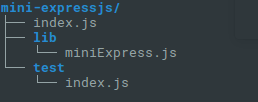
Let’s start from the official example of Hello-world. But before we start lets confirm the directory structure. We are calling our lib as mini-expressjs.
1. First Version
In the first version of our code, we will implement two functionality.
- http server.
getroute request
Let’s create a createApplication function that exposes two function listen and get .
listen function intercept all HTTP request, so that our mini-expressjs can analyze each HTTP request and can handle different business logic according to the different HTTP request. To expose this we can create an http.createServer and return this value from a listen function.
creating an http server can be done with the examples provided on the node.js official site.
Each HTTP request can be distinguished by the policies included in the URL’s. Like HTTP request noun, user-agent and so-on.
All the frameworks have different some sort of Routing Management. In our case we need a set of functions for managing HTTP requests and map it to the business logic. For this version we are going to implement get function that will be responsible for adding the get requests.
Basic Properties of each route abstracted from expressjs framework:
- Request path, for example:
/foo,/bar. - Request Method, for example:
GET,POST,PUT,DELETE. - Handle, Request Handler.
Let’s create an array of router to manage all of the route in our app. router[0] contains the handle function if none of the match is successful.
let’s modify the listen function to intercept the HTTP request and match the router routing table.
Let’s us implement the get route request. This function will simply add the get request route information to the router array.
But before we start our server and run the code, we have to add res.send function as this function is not a nodejs native function. This function is added on the res object.
Our final version of listen function till now.
All the code till this point can be found on v1-tree-of-repo . Clone it go to test folder run and visit browser, you will see “Hello World” printed.

2. Second Version
Let’s start the second iteration of our initial version of mini-expressjs. The Goal of this version is to enhance our routing system.
In expressjs The Routing System is composed of Three Class
- Router
- Route
- Layer
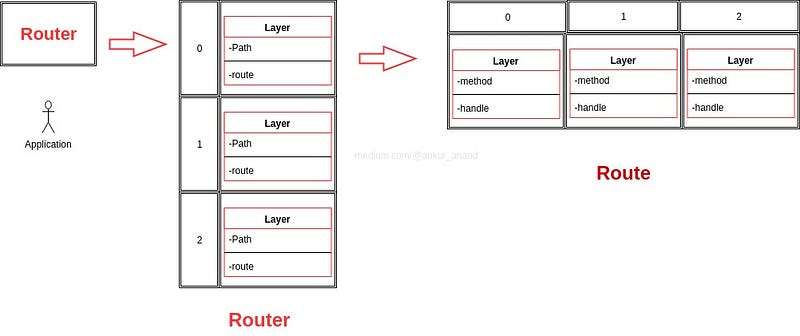
Lets first dismantle the above structure of the expressjs routing system.
The Router inside the application represent’s the routing component and is responsible for the entire routing system of the application.
Each Instance of
Routerconsists of an array ofLayers, and each Layer represents a set of routing information with the same path. The specific information is stored inside the instance of theRouteclass, where each route is also aLayerObject.
However, the Layer inside the Route and the Layer inside the Router contains different information.
- The Layer inside the Router mainly contains the
pathandroute. - The Layer inside the Route mainly contains the
methodandhandle.
Simply put when request comes, each layer inside the router is scanned from beginning to end, path gets compared first and the methods for that path is compared inside the route. If the match is successful, the specific information is returned otherwise return not found.
So in Our Application, a route will be composed of three parts: path, methods, and handlers. The relationship between the path and methods is one-to-many, example
GET foo/1
PUT foo/1
POST foo/1
So if we continue to add the routes to normal array like this, our number of routes will continue to increase drastically and the matching efficiency will continue to decrease.
But if we can combine the routes with the same route into a group, our efficiency will increase a lot and so the concept of layer was introduced at the expressjs. Lets implement the same in our mini-express where array in the Router system represents a layer and each layer contains three properties.
- Path, path of the route.
- Handle, function to handle the request.
- Route, the real route.
Lets Implement Layer class
and each item of our Router class now represents a Layer.
Let’s encapsulate the routing data and operations inside the Router class.
However if you look closely till now our program can’t distinguish between HTTP verbs now. Therefore we need to tell our Router to somehow figure out, and that is done through the route attribute stored inside the Router.
Route.js
Let’s change our Router class to use the new Route System.
Volha! Start the app from the test folder again and now our app can distinguish between different method too. ☺️
You Can find the code till now at v2-branch.
So with that in place we have created a mini sized version of the expressjs routing system for our application.
Still mini sized version only ? Oh Yes, because Just Like her

So in the next Post, I will be continue improving our routing system that supports Rich interface and middleware .
Stay Tuned!

✉️ Subscribe to CodeBurst’s once-weekly Email Blast, 🐦 Follow CodeBurst on Twitter, view 🗺️ The 2018 Web Developer Roadmap, and 🕸️ Learn Full Stack Web Development.
Originally published at medium.com.